

- Free Valuation
- Competitive Sales Commission Fees
- Free Mortgage Advice
posted 16th January 2026
M18 Market Overview
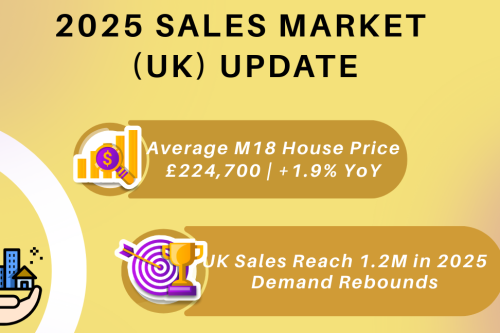
- Average House Price: £224,700
- Annual Price Growth: +1.9%
M18 has closed 2025 with steady price performance and consistent buyer demand, reflecting the wider strength seen across northern markets. Annual price growth remains ahead of the UK average, supported by affordability and sustained interest from owner-occupiers.
National Housing Market Context
The UK housing market recorded a clear recovery in 2025, with total housing transactions reaching approximately 1.2 million, the highest annual level for three years and close to the long-term average. Improved mortgage affordability, stabilising interest rates, and rising household incomes have all contributed to renewed confidence among buyers.
Although overall sales volumes increased, house price growth across the UK slowed to 1.1% year-on-year, down from 1.9% in 2024. This moderation reflects the ongoing adjustment to higher borrowing costs and increased stamp duty, rather than a lack of demand.
The total value of residential sales in 2025 is estimated at £367 billion, highlighting the continued scale and resilience of the housing market.
Buyer Behaviour and Demand
First-time buyers played a central role in driving activity throughout 2025, accounting for around 39% of all sales, making them the largest buyer group. Existing homeowners purchasing with a mortgage represented approximately one-third of transactions, while cash buyers made up just over one-fifth. Landlords using mortgage finance accounted for a smaller share, at around 7%.
Improved mortgage availability from spring 2025 significantly boosted affordability for buyers reliant on borrowing. As a result, first-time buyer activity is estimated to be around 20% higher than in 2024, lifting their market share above the long-term average seen between 2000 and 2024.
This trend has been particularly evident in areas such as M18, where price levels remain accessible relative to national benchmarks.
Late-Year Slowdown and Budget Impact
Housing activity softened towards the end of 2025, with Q4 recording the sharpest fall in new sales agreed since 2022. This slowdown was driven not only by seasonal factors but also by uncertainty and speculation surrounding the Autumn Budget, prompting some buyers to delay decisions.
By December, buyer demand was running approximately 12% below the same period last year, with sales agreed down around 9% year-on-year. However, this slowdown is not expected to materially affect 2025 completion totals, as housing transactions typically complete several months after being agreed.
Instead, the impact is likely to feed into early 2026 figures.
House Price Trends and Regional Performance
Despite increased transaction volumes, national house price growth remained subdued. A pronounced north–south divide continues to define the market:
Prices across much of southern England were flat or slightly lower, with some areas seeing declines of up to 0.6% due to affordability pressures.
In contrast, northern England and Scotland recorded stronger growth, supported by lower average prices and better value for money.
The North West recorded annual price growth of around 2.9%, reinforcing the region’s position as one of the strongest performers nationally. M18’s 1.9% annual growth reflects this wider regional trend while remaining sustainable rather than overheated.
At a local level across the UK, price movements varied significantly, with some northern and Scottish markets seeing growth above 4%, while parts of southern coastal England experienced notable price declines.
Market Valuation and Affordability
By the end of 2025, UK house prices are considered broadly “fairly valued.” During 2023, rapid interest rate increases pushed prices significantly above affordability benchmarks, which explains the subdued price growth over the past three years.
As mortgage competition has intensified, average borrowing costs have stabilised close to 4%, helping affordability gradually reset. This creates scope for prices to rise broadly in line with income growth, assuming no major economic shocks or aggressive changes in lending criteria.
Outlook for 2026
Looking ahead, early 2026 is expected to benefit from a release of delayed demand as buyers who paused decisions in late 2025 return to the market. This is likely to result in a stronger-than-usual first quarter.
- Estimated housing transactions for 2026: 1.18 million
- Projected average house price growth in 2026: +1.5%
Sales volumes are expected to remain close to long-run averages, supported by a high number of homes for sale and improved buyer choice. However, affordability will continue to influence purchasing decisions, particularly for first-time buyers and those upsizing.
Sellers in all regions, including M18, will need to remain realistic on pricing to secure successful transactions in a competitive market.
Summary
M18 enters 2026 from a position of relative stability. Modest price growth, steady rental performance, and strong first-time buyer demand continue to underpin the local market. While national conditions point to slower price inflation, the outlook for sales activity remains positive, particularly in well-priced, affordable areas across the North West.


